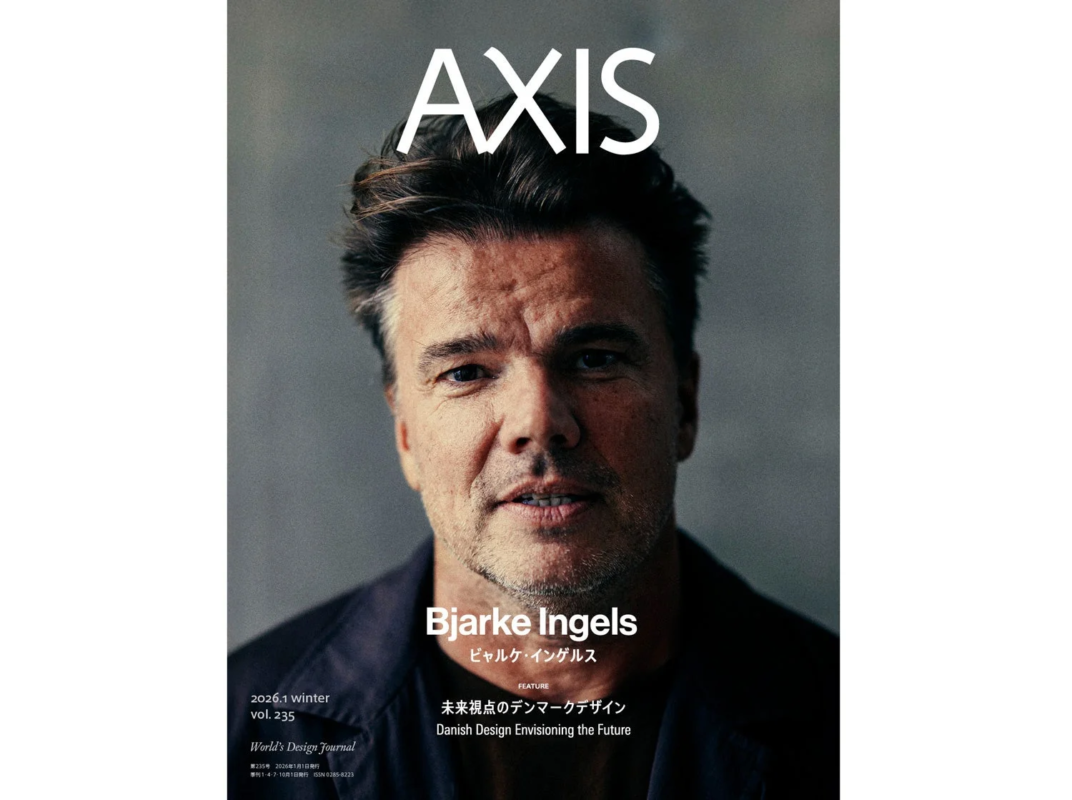
デザイン誌「AXIS」最新号vol.235が2025年12月27日に発売!未来を創造するデンマークデザイン、建築、食、ファッションの全貌を徹底解説

デザイン誌「AXIS」最新号vol.235が12月27日発売!未来を創造するデンマークデザインの全貌を徹底解説

デザイン、建築、そして持続可能な社会のあり方を深く探求するデザイン誌「AXIS」の最新号vol.235が、2025年12月27日(土)に発売されます。今回の特集は「未来視点のデンマークデザイン」。世界で最も注目される建築家の一人、ビャルケ・インゲルス氏が表紙を飾り、彼の哲学からデンマークの豊かなデザイン文化まで、多角的に「未来」を読み解く一冊となっています。

「未来を見据えた視点」は、現代のものづくりにおいて不可欠な要素です。デンマークのデザインは、この視点を軽やかに取り入れ、創造の原動力に変えています。環境負荷や製品寿命、労働環境までを考慮しながら、美しさや心地よさに妥協しない彼らのアプローチは、日々の暮らしをより良くするための選択の積み重ねから生まれています。

AXIS 2026.1 winter vol. 235 World's Design Journal Bjarke Ingels ビャルケ・インゲルス FEATURE 未来視点のデンマークデザイン Danish Design Envisioning the Future 第235号 2026年1月1日発行 季刊1・4・7・10月1日発行 ISSN 0285-8223

カバー・ストーリー:ビャルケ・インゲルス氏が語る「快楽主義的な持続可能性」

最新号の表紙を飾るのは、ビャルケ・インゲルス・グループ(BIG)の創設者でありクリエイティブディレクターを務めるビャルケ・インゲルス氏です。彼は「快楽主義的な持続可能性」という独自の哲学を提唱しており、これは世の中の複雑な矛盾を統合し、優れた解決策を生み出すという考え方です。
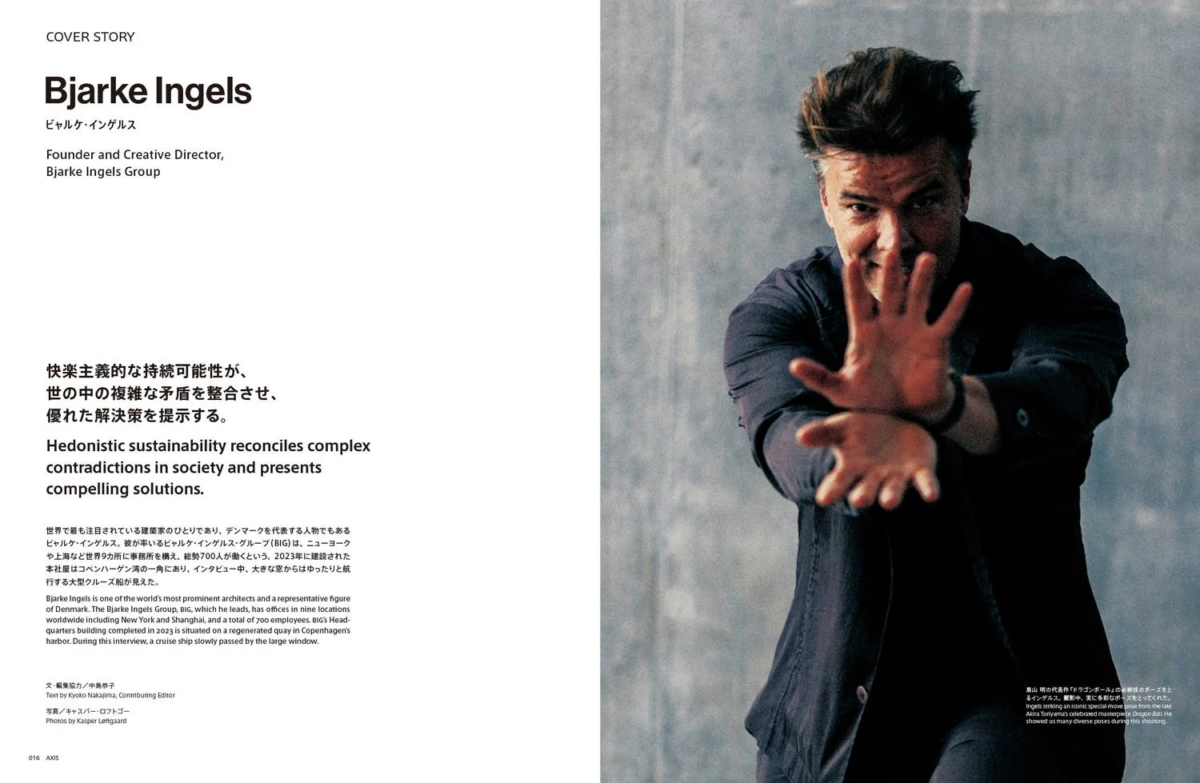
COVER STORY Bjarke Ingels ビャルケ・インゲルス Founder and Creative Director, Bjarke Ingels Group 快楽主義的な持続可能性が、 世の中の複雑な矛盾を整合させ、 優れた解決策を提示する。 Hedonistic sustainability reconciles complex contradictions in society and presents compelling solutions. 世界で最も注目されている建築家の一人であり、デンマークを代表する人物でもあるビャルケ・インゲルス。彼が率いるビャルケ・インゲルス・グループ (BIG) は、ニューヨークや上海など世界9カ所に事務所を構え、総勢700人が働くという。2023年に建設された本社屋はコペンハーゲン湾の一角にあり、インタビュー中、大きな窓からはゆったりと航行する大型クルーズ船が見えた。 Bjarke Ingels is one of the world's most prominent architects and a representative figure of Denmark. The Bjarke Ingels Group, BIG, which he leads, has offices in nine locations worldwide including New York and Shanghai, and a total of 700 employees. BIG's headquarters building completed in 2023 is situated on a regenerated quay in Copenhagen's harbor. During this interview, a cruise ship slowly passed by the large window. 文・編集協力 / 中島恭子 Text by Kyoko Nakajima, Contributing Editor 写真 / キャスパー・レフトゴー Photos by Kasper Lehtgaard 016 AXIS 鳥山明の代表作「ドラゴンボール」の必殺技のポーズをとるインゲルス。撮影中、多様なポーズを披露したという。 Ingels strikes an iconic special move pose from the late Akira Toriyama's celebrated masterpiece Dragon Ball. He showed us many diverse poses during this shooting.

BIGはニューヨークや上海など世界9カ所に拠点を持ち、総勢700人が働く国際的な建築集団です。2023年にコペンハーゲン湾に建設された本社屋でのインタビューでは、彼の建築に対する深い洞察と、未来へのビジョンが語られています。

大特集:未来視点のデンマークデザインに迫る

今回のメイン特集「未来視点のデンマークデザイン」では、デンマークがどのようにして未来を見据えたものづくりや社会システムを構築しているのかを多角的に検証します。
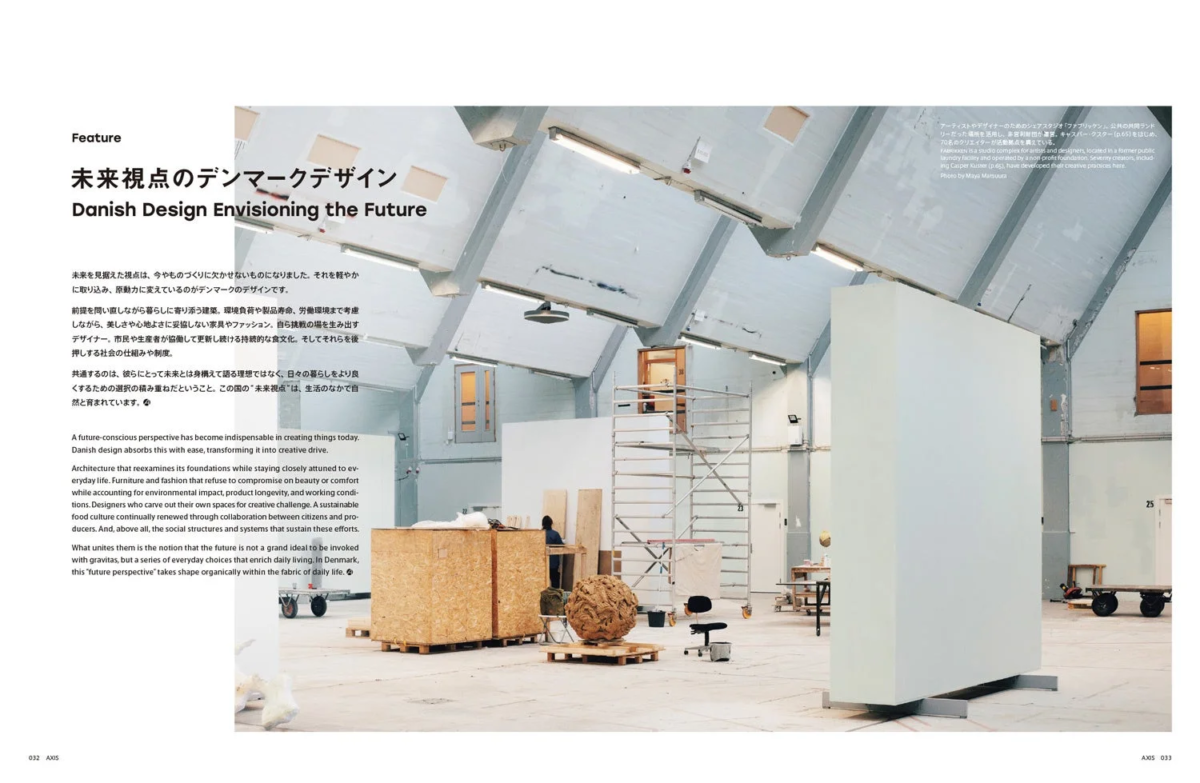
Feature 未来視点のデンマークデザイン Danish Design Envisioning the Future 未来を見据えた視点は、今やものづくりに欠かせないものになりました。それを軽やかに取り込み、原動力に変えているのがデンマークのデザインです。 前提を問い直しながら暮らしに寄り添う建築、環境負荷や製品寿命、労働環境まで考慮 しながら、美しさや心地よさに妥協しない家具やファッション。自ら挑戦の場を生み出す デザイナー、市民や生産者が協働して更新し続ける持続的な食文化。そしてそれらを後 押しする社会の仕組みや制度。 共通するのは、彼らにとって未来とは身構えて語る理想ではなく、日々の暮らしをより良 くするための選択の積み重ねだということです。この国の“未来視点”は、生活のなかで自 然と育まれています。 A future-conscious perspective has become indispensable in creating things today. Danish design absorbs this with ease, transforming it into creative drive. Architecture that reexamines its foundations while staying closely attuned to ev- eryday life. Furniture and fashion that refuse to compromise on beauty or comfort while accounting for environmental impact, product longevity, and working condi- tions. Designers who carve out their own spaces for creative challenge. A sustainable food culture continually renewed through collaboration between citizens and pro- ducers. And, above all, the social structures and systems that sustain these efforts. What unites them is the notion that the future is not a grand ideal to be invoked with gravitas, but a series of everyday choices that enrich daily living. In Denmark, this "future perspective" takes shape organically within the fabric of daily life. アーティストやデザイナーのためのシェアスタジオ「ファブリッケン」。公共の共同ランド リーだった場所を活用し、非営利財団が運営。キャスパー・クスター (p.65) をはじめ、 70名のクリエイターが活動拠点を構えている。 Fabrikken is a shared studio for artists and designers, located in a former public laundry facility and operated by a non-profit foundation. Seventy creators, includ- ing Casper Kuster (p.65), have developed their creative practices here. Photo by Maya Matsuiuta AXIS 032 AXIS 033

暮らしが育てるコペンハーゲンの街:人間中心の都市開発

デンマークの首都コペンハーゲンでは、公園や運河で人々がくつろぎ、自転車が主要な交通手段として活用される、心地よい日常が息づいています。現在、各地で再開発が進められていますが、その根底にあるのは「人々の暮らしを大切にする」という哲学です。
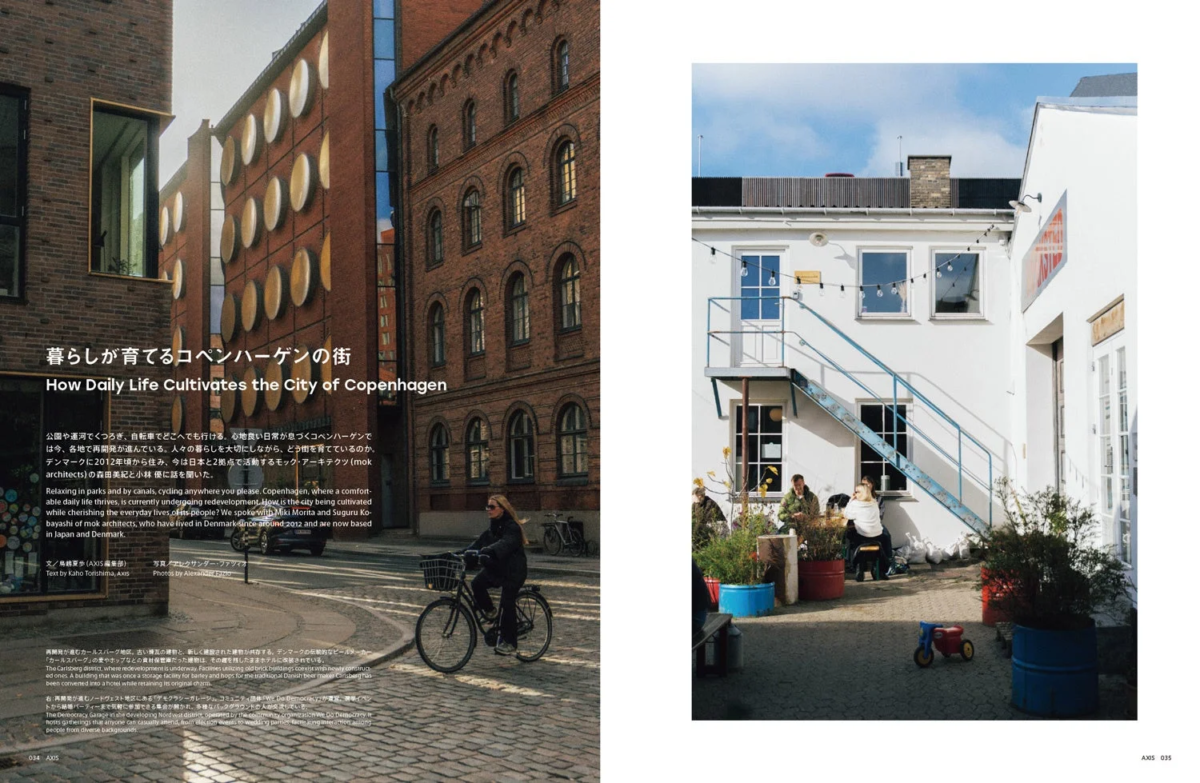
暮らしが育てるコペンハーゲンの街 How Daily Life Cultivates the City of Copenhagen 公園や運河でくつろぎ、自転車でどこへでも行ける。心地良い日常が見つくコペンハーゲンでは今、各地で再開発が進んでいる。人々の暮らしを大切にしながら、どう市を育てているのか。デンマークに2012年頃から住み、今は日本と2拠点で活動するモック・アーキテクツ(mok architects)の森田美紀と小林優に話を聞いた。 Relaxing in parks and by canals, cycling anywhere you please. Copenhagen, where a comfortable daily life thrives, is currently undergoing redevelopment. How is the city being cultivated while cherishing the everyday lives of its people? We spoke with Miki Morita and Suguru Kobayashi of mok architects, who have lived in Denmark since around 2012 and are now based in Japan and Denmark. 文 / 桑島 葉歩 (AXIS 編集部) Text by Kaho Kawahima, Axis 写真 / アレクサンダー・フッツィア Photos by Alexander Hutsia 再開発が進むカールスバーグ地区。古い煉瓦の建物と、新しく建設された建物が共存する。デンマークの伝統的なビールメーカー「カールスバーグ」の家やホップなどの資材保管場だった建物は、その趣を残したままホテルに改築されている。 The Carlsberg district, where redevelopment is underway. Facilities utilizing old brick buildings coexist with newly constructed ones. A building that was once a storage facility for barley and hops for the traditional Danish beer maker Carlsberg has been converted into a hotel while retaining its original charm. デモクラシー・ガレージというNPO法人によって運営されている。 The Democracy Garage in the developing Nordvest district, operated by the community organization We Do Democracy. It hosts gatherings that anyone can casually attend, from election events to wedding parties, fostering interaction among people from diverse backgrounds. 034 AXIS 035

デンマークに2012年頃から住み、現在は日本とデンマークの2拠点で活動するモック・アーキテクツの森田美紀氏と小林優氏のインタビューを通じて、コペンハーゲンの街がどのように人々の暮らしを育んでいるのかが紹介されます。

時代を静かに更新する家具ブランドとデザイナー:サステナビリティとクラフトマンシップの融合

現代において「ものづくり」が持つ意味と責任を見つめ直し、真のサステナビリティを実践するデンマークの家具ブランドとデザイナーが特集されます。彼らは伝統的なクラフトマンシップを大切にしながら、環境負荷や製品寿命、労働環境まで考慮し、新しい価値観を静かにアップデートしています。
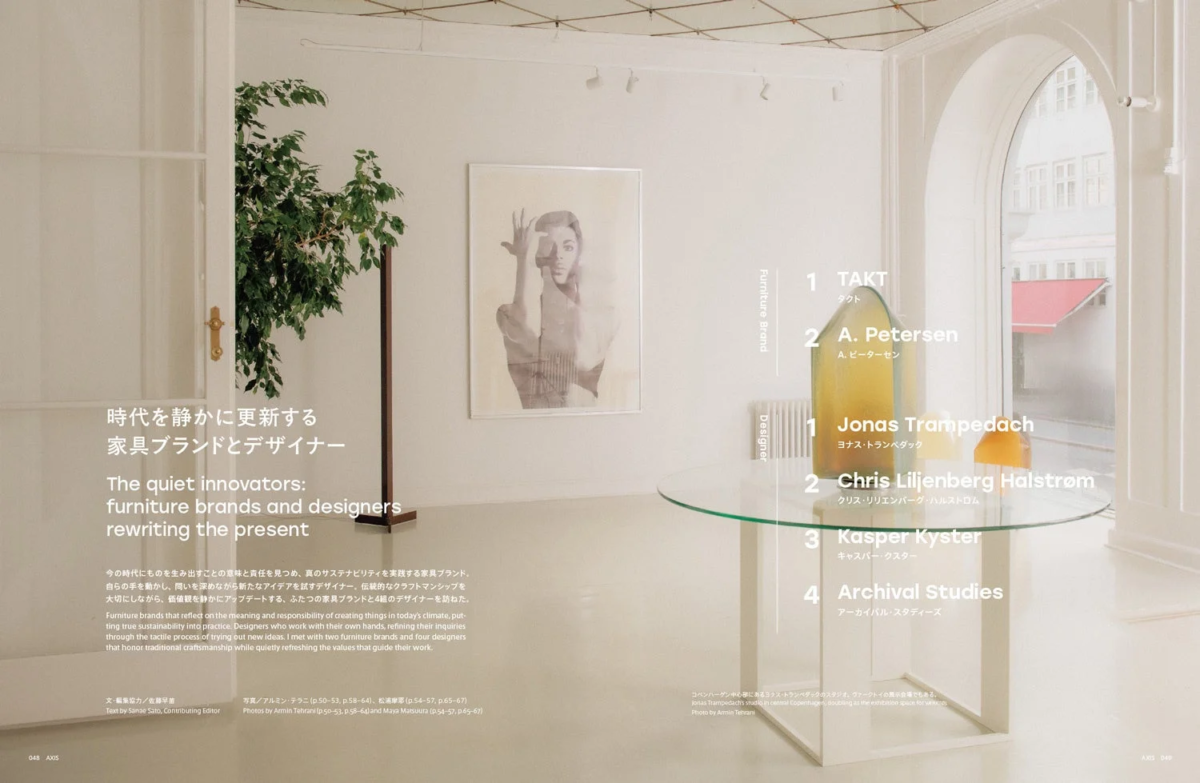
時代を静かに更新する 家具ブランドとデザイナー The quiet innovators: furniture brands and designers rewriting the present 今の時代にものを生み出すことの意味と責任を見つめ、真のサステナビリティを実践する家具ブランド。自らの手を動かし、問いを深めながら新たなアイデアを試すデザイナー。伝統的なクラフトマンシップを大切にしながら、価値観を静かにアップデートする、ふたつの家具ブランドと4組のデザイナーを訪ねた。 Furniture brands that reflect on the meaning and responsibility of creating things in today's climate, putting true sustainability into practice. Designers who work with their own hands, refining their inquiries through the tactile process of trying out new ideas. I met with two furniture brands and four designers that honor traditional craftsmanship while quietly refreshing the values that guide their work. 文・編集協力 / 佐藤早苗 Text by Sanae Saito, Contributing Editor 写真 / アルミン・テラニ (p.50-53, p.58-64)、松浦摩耶 (p.54-57, p.65-67) Photos by Armin Tehrani (p.50-53, p.58-64) and Maya Matsuura (p.54-57, p.65-67) 048 AXIS Furniture Brand 1 TAKT タクト 2 A. Petersen A. ピーターセン Designer 1 Jonas Trampedach ヨナス・トランペダック 2 Chris Liljenberg Halstrøm クリス・リリエンバーグ・ハルストロム 3 Kasper Kyster キャスパー・クスター 4 Archival Studies アーカイバル・スタディーズ コペンハーゲン中心部にあるヨナス・トランペダックのスタジオ。タクトの展示会場でもある。Jonas Trampedach's studio in central Copenhagen, doubling as the exhibiting space for TAKT. Photo by Armin Tehrani AXIS 049

2つの家具ブランド「タクト」と「A. ピーターセン」、そしてヨナス・トランぺダック、クリス・リリエンバーグ・ハルストロム、キャスパー・クスター、アーカイバル・スタディーズの4組のデザイナーの挑戦が紹介されます。

協働がつくる食文化:進化し続けるデンマークの日常食とオーガニック先進国としての取り組み

デンマークの食文化といえば、世界的に有名なレストラン「ノーマ(Noma)」を思い浮かべる人も多いでしょう。しかし、ノーマに注目が集まる一方で、デンマークの日常食もまた、未来を見据えた視点で進化を続けています。
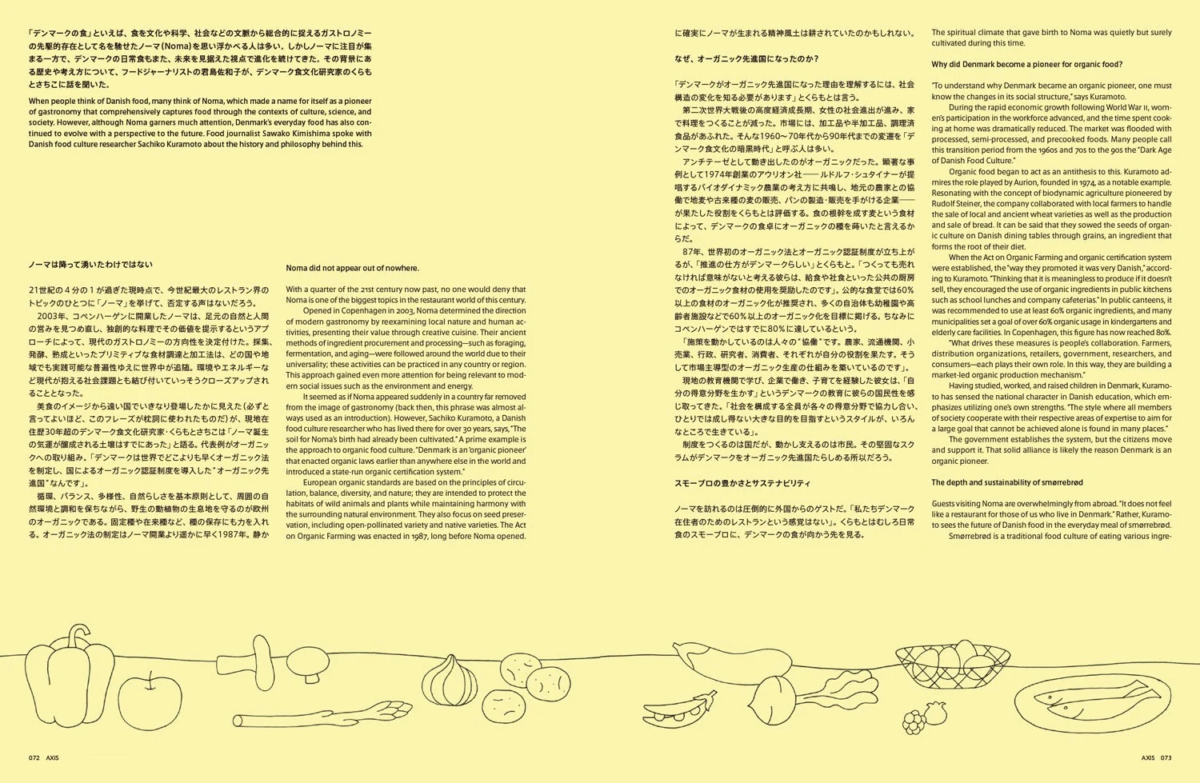
「デンマークのオーガニック食」といえば、食文化や科学、社会などの文脈から総合的に捉えるガストロノミーの先駆的存在として名を馳せたノーマ(Noma)を思い浮かべる人は多い。しかしノーマに注目が集まる一方で、デンマークの日常食もまた、未来を見据えた視点で進化を続けてきた。その背景にある歴史や考え方について、フードジャーナリストの岩島佐和子と、デンマーク食文化研究家のくらもとさちこに話を聞いた。 When people think of Danish food, many think of Noma, which made a name for itself as a pioneer of gastronomy that comprehensively captures food through the contexts of culture, science, and society. However, although Noma garners much attention, Denmark's everyday food has also continued to evolve with a perspective to the future. Food journalist Sawako Kimishima spoke with Danish food culture researcher Sachiko Kuramoto about the history and philosophy behind this. ノーマは降って湧いたわけではない Noma did not appear out of nowhere. 21世紀の4分の1が過ぎた現時点で、今世紀最大のレストラン界のトピックのひとつに「ノーマ」を挙げて、否定する声はないだろう。 2003年、コペンハーゲンに開業したノーマは、足元の自然と人間の営みを見つめ直し、独創的な料理でその価値を提示するというアプローチによって、現代のガストロノミーの方向性を決定付けた。採集、発酵、熟成といったプリミティブな食材調達と加工法は、どの国や地域でも実践可能な普遍性ゆえに世界中が追随。環境やエネルギーなど現代が抱える社会課題とも結び付いていっそうクローズアップされることとなった。 美食のイメージから遠い国でいきなり登場したかに見えた(必ずと言ってよいほど、このフレーズが枕詞に使われたものだ)が、現在在住歴30年のデンマーク食文化研究家・くらもとさちこは「ノーマ誕生の気運が醸成される土壌はすでにあった」と語る。代表例がオーガニックへの取り組み。「デンマークは世界でどこよりも早くオーガニック法を制定し、国によるオーガニック認証制度を導入した“オーガニック先進国”なんです」。 循環、バランス、多様性、自然らしさを基本原則として、周囲の自然環境と調和を保ちながら、野生の動植物の生息地を守るのが欧州のオーガニックである。固定種や在来種など、種の保存にも力を入れNoma did not appear out of nowhere. With a quarter of the 21st century now past, no one would deny that Noma is one of the biggest topics in the restaurant world of this century. Opened in Copenhagen in 2003, Noma determined the direction of modern gastronomy by reexamining local nature and human activities, presenting their value through creative cuisine. Their ancient methods of ingredient procurement and processing—such as foraging, fermentation, and aging—were followed around the world due to the universality; these activities can be practiced in any country or region. This approach gained even more attention for being relevant to modern social issues such as the environment and energy. It seemed as if Noma appeared suddenly in a country far removed from the image of gastronomy (back then, this phrase was almost always used as an introduction). However, Sachiko Kuramoto, a Danish food culture researcher who has lived there for over 30 years, says, "The soil for Noma's birth had already been cultivated." A prime example is the approach to organic food culture. "Denmark is an 'organic pioneer' that enacted organic laws earlier than anywhere else in the world and introduced a state-run organic certification system." European organic standards are based on the principles of circulation, balance, diversity, and nature; they are intended to protect the habitats of wild animals and plants while maintaining harmony with the surrounding natural environment. They also focus on seed preservation, including open-pollinated variety and native varieties. The Act on Organic Farming was enacted in 1987, long before Noma opened. に確実にノーマが生まれる精神風土は耕されていたのかもしれない。 なぜ、オーガニック先進国になったのか? デンマークがオーガニック先進国になった理由を理解するには、社会構造の変化を知る必要があります」とくらもとは言う。 第二次世界大戦後の高度経済成長期、女性の社会進出が進み、家で料理をつくることが減った。市場には、加工品や半加工品、調理済み食品があふれた。そんな1960~70年代から90年代までを「デンマーク食文化の暗黒時代」と呼ぶ人も多い。 アンチテーゼとして動き出したのがオーガニックだった。簡素な事例として1974年創業のアウリオン社―ルドルフ・シュタイナーが提唱するバイオダイナミック農業の考え方に共鳴し、地元の農家と協働で地産や古来種の麦の販売、パンの製造・販売を手がける―が果たした役割をくらもとは評価する。食の根幹を成す麦という食材によって、デンマークの食卓にオーガニックの種を蒔いたと言えるからだ。 87年、世界初のオーガニック法とオーガニック認証制度が立ち上がったが、「推進の仕方がデンマークらしい」とくらもと。「つくっても売れなければ意味がないと考える彼らは、給食や社会食といった公共の厨房でのオーガニック食材の使用を奨励したのです」。公的な食堂では60%以上の食材のオーガニック化が推奨され、多くの自治体も幼稚園や高齢者施設などで60%以上のオーガニック化を目標に掲げる。ちなみにコペンハーゲンではすでに80%に達しているという。 「施策を動かしているのは人々の“協働”です。農家、流通機関、小売業、行政、研究者、消費者、それぞれが自分の役割を果たす。そうして市場主導型のオーガニック生産の仕組みを築いているのです」。 現地の教育機関で学び、企業で働き、子育てを経験した彼女は、「自分の得意分野を生かす」というデンマークの教育に彼らの国民性を感じ取ってきた。「社会を構成する全員が各々の得意分野で協力し合い、ひとりでは成し得ない大きな目的を目指すというスタイルが、いろんなところで生きている」。 制度をつくるのは国だが、動かし支えるのは市民。その堅固なスクラムがデンマークをオーガニック先進国たらしめる所以だろう。 スモープロの豊かさとサステナビリティ ノーマを訪れるのは圧倒的に外国からのゲストだ。「私たちデンマーク在住者のためのレストランという感覚はない」。くらもとはむしろ日常食のスモープロに、デンマークの食が向かう先を見る。 the spiritual climate that gave birth to Noma was quietly but surely cultivated during this time. Why did Denmark become a pioneer for organic food? "To understand why Denmark became an organic pioneer, one must know the changes in its social structure," says Kuramoto. During the rapid economic growth following World War II, women's participation in the workforce advanced, and the time spent cooking at home was dramatically reduced. The market was flooded with processed, semi-processed, and precooked foods. Many people call this transition period from the 1960s and 70s to the gos the "Dark Age of Danish Food Culture." Organic food began to act as an antithesis to this. Kuramoto admires the role played by Aurion, founded in 1974, as a notable example. Resonating with the concept of biodynamic agriculture pioneered by Rudolf Steiner, the company collaborated with local farmers to handle the sale of local and ancient wheat varieties as well as the production and sale of bread. It can be said that they sowed the seeds of organic culture on Danish dining tables through grains, an ingredient that forms the root of their diet. When the Act on Organic Farming and organic certification system were established, "the way they promoted it was very Danish," accord-ing to Kuramoto. "Thinking that it is meaningless to produce it if it doesn't sell, they encouraged the use of organic ingredients in public kitchens such as school lunches and company cafeterias." In public canteens, it was recommended to use at least 60% organic ingredients, and many municipalities set a goal of over 60% organic usage in kindergartens and elderly care facilities. In Copenhagen, this figure has now reached 80%. "What drives these measures is people's collaboration. Farmers, distribution organizations, retailers, government, researchers, and consumers—each plays their own role. In this way, they are building a market-led organic production mechanism." Having studied, worked, and raised children in Denmark, Kuramo-to has sensed the national character in Danish education, which em-phasizes utilizing one's own strengths. "The style where all members of society cooperate with their respective areas of expertise to aim for a large goal that cannot be achieved alone is found in many places." The government establishes the system, but the citizens move and support it. That solid alliance is likely the reason Denmark is an organic pioneer. The deep and sustainability of smørrebrød Guests visiting Noma are overwhelmingly from abroad. "It does not feel like a restaurant for those of us who live in Denmark." Rather, Kuramo-to sees the future of Danish food in the everyday meal of smørrebrød. Smørrebrød is a traditional food culture of eating various ingre- AXIS 072 AXIS 073

フードジャーナリストの君島佐和子氏とデンマーク食文化研究家のくらもとさちこ氏の対談では、デンマークが世界に先駆けてオーガニック法を制定し、国による認証制度を導入した「オーガニック先進国」である背景が語られます。社会の仕組みや制度が、市民や生産者の「協働」によってどのように支えられ、持続的な食文化を育んでいるのかが明らかになります。

美しさと責任を両立させるデンマークファッションの今:サステナブルな潮流

ファッション業界において「サステナブル最先端」と称されるデンマーク。パリの物語性やミラノのラグジュアリーとは異なり、機能性と控えめな美意識を土台に、環境配慮と社会的責任がデザイン思想を育んできました。
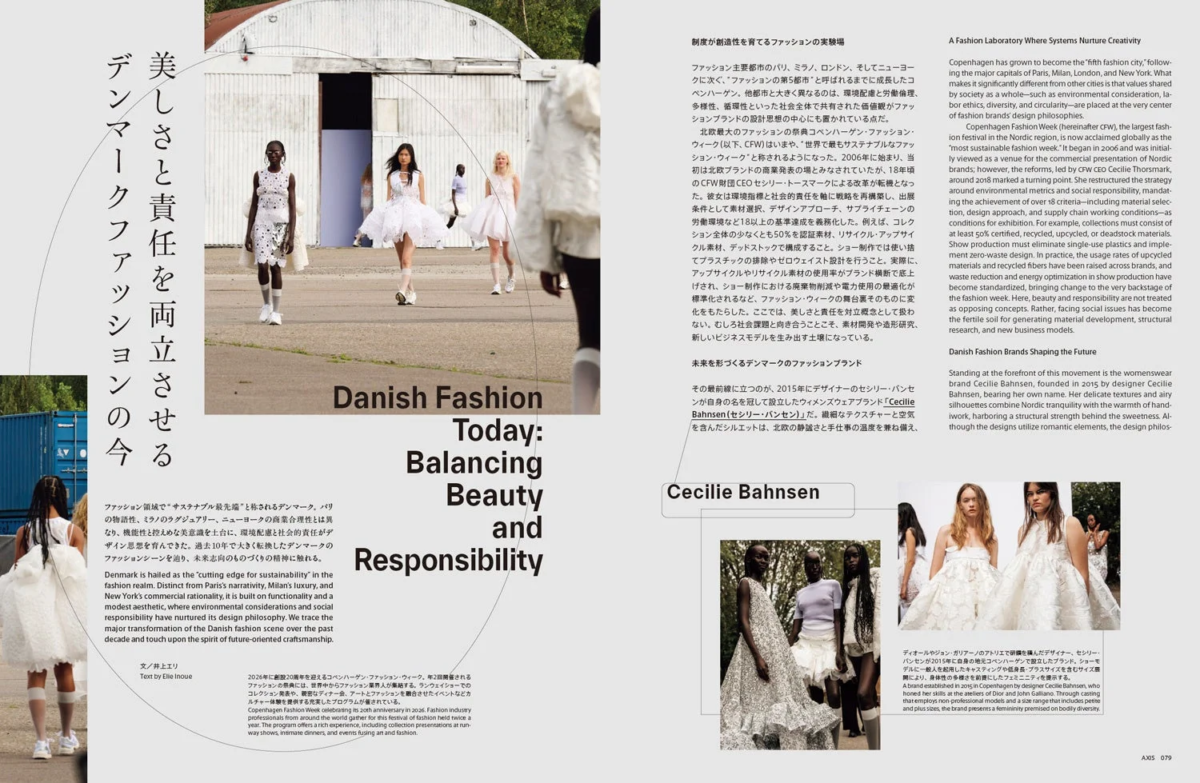
美しさと責任を両立させるデンマークファッションの今 制度が創造性を育てるファッションの実験場 Danish Fashion Today: Balancing Beauty and Responsibility ファッション領域で“サステナブル最先端”と称されるデンマーク。パリ の物語性、ミラノのラグジュアリー、ニューヨークの商業合理性とは異 なり、機能性と控えめな美意識を土台に、環境配慮と社会的責任がデザ イン思想を育んできた。過去10年で大きく転換したデンマークの ファッションシーンを巡り、未来志向のものづくりの精神に触れる。 Denmark is hailed as the “cutting edge for sustainability” in the fashion realm. Distinct from Paris's narrativity, Milan's luxury, and New York's commercial rationality, it is built on functionality and a modest aesthetic, where environmental considerations and social responsibility have nurtured its design philosophy. We trace the major transformation of the Danish fashion scene over the past decade and touch upon the spirit of future-oriented craftsmanship. 文/井上エリ Text by Ellie Inoue 制度が創造性を育てるファッションの実験場 ファッション主要都市のパリ、ミラノ、ロンドン、そしてニューヨー クに次ぐ、“ファッションの第5都市”と呼ばれるまでに成長したコ ペンハーゲン。他都市と大きく異なるのは、環境配慮、多様性、倫理 性といった社会全体で共有された価値観がファッションブランドの 設計思想の中心にも置かれている点だ。 北欧最大のファッションの祭典コペンハーゲン・ファッション・ ウィーク(以下、CFW)はいまや、“世界で最もサステナブルなファッ ション・ウィーク”と称されるようになった。2006年に始まり、当 初は北欧ブランドの商業発表の場とみなされていたが、18年頃 のCFW財団CEOセシリー・トースマークによる改革が転機となっ た。彼女は環境指標と社会的責任を軸に戦略を構築し、出展 条件として素材選択、デザインアプローチ、サプライチェーンの 労働環境など18以上の基準達成を義務化した。例えば、コレク ション全体の少なくとも50%を認証素材、リサイクル・アップサイ クル素材、デッドストックで構成すること。ショー制作では使い捨 てプラスチックの排除やゼロウェイスト設計を行うこと、実際に、 アップサイクルやリサイクル素材の使用率がブランド横断で底上 げされ、ショー制作における廃棄物削減や電力使用の最適化が 標準化されるなど、ファッション・ウィークの舞台裏そのものに 変化をもたらした。ここでは、美しさと責任を対立概念として扱わ ない。むしろ社会課題と向き合うことこそ、素材開発や造形研究、 新しいビジネスモデルを生み出す土壌になっている。 未来を形づくるデンマークのファッションブランド その最前線に立つのが、2015年にデザイナーのセシリー・バンセ ンが自身の名を冠して設立したウィメンズウェアブランド「Cecilie Bahnsen(セシリー・バンセン)」だ。繊細なテクスチャーと空気 を含んだシルエットは、北欧の静謐さと手仕事の温度を兼ね備え、 A Fashion Laboratory Where Systems Nurture Creativity Copenhagen has grown to become the “fifth fashion city,” follow- ing the major capitals of Paris, Milan, London, and New York. What makes it significantly different from other cities is that values shared by society as a whole—such as environmental consideration, la- bor ethics, diversity, and circularity—are placed at the very center of fashion brands' design philosophies. Copenhagen Fashion Week (hereinafter CFW), the largest fash- ion festival in the Nordic region, is now acclaimed globally as the “most sustainable fashion week.” It began in 2006 and was initial- ly viewed as a venue for the commercial presentation of Nordic brands; however, the reforms, led by CFW CEO Cecilie Thorsmark, around 2018 marked a turning point. She restructured the strategy around environmental metrics and social responsibility, mandat- ing the achievement of over 18 criteria—including material selec- tion, design approach, and supply chain working conditions—as conditions for exhibition. For example, collections must consist of at least 50% certified, recycled, upcycled, or deadstock materials. Show production must eliminate single-use plastics and imple- ment zero-waste design. In practice, the usage rates of upcycled materials and recycled fibers have been raised across brands, and waste reduction and energy optimization in show production have become standardized, bringing change to the very backstage of the fashion week. Here, beauty and responsibility are not treated as opposing concepts. Rather, facing social issues has become the fertile soil for generating material development, structural research, and new business models. Danish Fashion Brands Shaping the Future Standing at the forefront of this movement is the womenswear brand Cecilie Bahnsen, founded in 2015 by designer Cecilie Bahnsen, bearing her own name. Her delicate textures and airy silhouettes combine Nordic tranquility with the warmth of hand- iwork, harboring a structural strength behind the sweetness. Al- though the designs utilize romantic elements, the design philos- Cecilie Bahnsen ディオール・ガリアーノのアトリエで研鑽を積んだデザイナー、セシリー・ バンセンが2015年に自身の地元コペンハーゲンで設立したブランド。ショーモ デルに一般人を起用したキャスティングや延長身長・プラスサイズを含むサイズ展 開により、身体性の多様さを前提にしたフェミニニティを提示する。 A brand established in 2015 in Copenhagen by designer Cecilie Bahnsen, who honed her skills at the ateliers of Dior and John Galliano. Through casting that employs non-professional models and a size range that includes petite and plus sizes, the brand presents a femininity premised on bodily diversity. AXIS 079

過去10年間で大きく変化したデンマークのファッションシーンを辿り、コペンハーゲンファッションウィーク(CFW)が「世界で最もサステナブルなファッションウィーク」と呼ばれるに至った経緯や、未来志向のものづくりの精神に触れます。

デンマーク建築はいま、世界の未来像を更新しているのか:持続可能性と創造性

都市計画から文化遺産まで、多様な領域で革新を続けるデンマーク建築。サステナビリティと創造性を両輪とし、地域性に根ざしたデザインから気候変動への応答、そして日常を豊かにする遊びの提案まで、その取り組みが紹介されます。
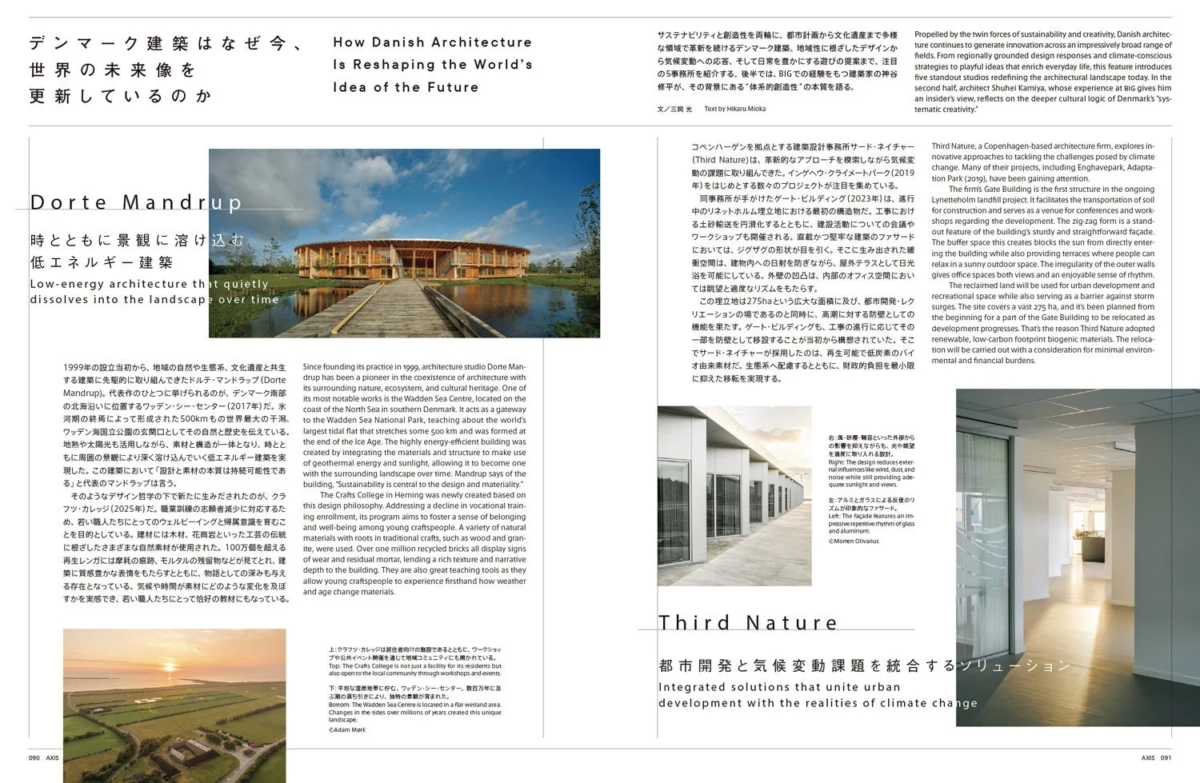
デンマーク建築はいま今、世界の未来像を更新しているのか How Danish Architecture Is Reshaping the World's Idea of the Future Dorte Mandrup 時とともに景観に溶け込む低エネルギー建築 Low-energy architecture that quietly dissolves into the landscape over time 1999年の設立当初から、地域の自然や生態系、文化遺産と共生する建築に先駆的に取り組んできたドルテ・マンドラップ (Dorte Mandrup)。代表作のひとつに挙げられるのが、デンマーク南部の北海沿いに位置するワッデン・シー・センター (2017年) だ。氷河期の終焉によって形成された500kmもの世界最大の干潟、ワッデン海国立公園の玄関口としてその自然と歴史を伝えている。地熱や太陽光も活用しながら、素材と構造が一体となり、時とともに周囲の景観により深く溶け込んでいく低エネルギー建築を実現した。この建築において「設計と素材の本質は持続可能性である」と代表のマンドラップは言う。そのようなデザイン哲学の下で新たに生みだされたのが、クラフツ・カレッジ (2025年) だ。最善訓練の高齢者減少に対応するため、若い職人たちにとってのウェルビーイングと帰属意識を育むことを目的としている。建材には木材、花崗岩といった工芸の伝統に根ざしたさまざまな自然素材が使用され、100万個を超える再生レンガには摩耗の痕跡、モルタルの残留物などが見てとれ、建築に質感豊かな表情をもたらすとともに、物語としての深みも与える存在となっている。気候や時間が素材にどのような変化を及ぼすかを実感でき、若い職人たちにとって恰好の教材にもなっている。 Since founding its practice in 1999, architecture studio Dorte Mandrup has been a pioneer in the coexistence of architecture with its surrounding nature, ecosystem, and cultural heritage. One of its most notable works is the Wadden Sea Centre, located on the coast of the North Sea in southern Denmark. It acts as a gateway to the Wadden Sea National Park, the world's largest tidal flat formed at the end of the Ice Age, stretching 500 km. The highly energy-efficient building was created by integrating the materials and structure to make use of geothermal energy and sunlight, allowing it to become one with the surrounding landscape over time. Mandrup says of this building, "Sustainability is central to the design and materiality." Another project born from this design philosophy is the Crafts College in Herning (2025). To address the decline in vocational training enrollment, its program aims to foster well-being and a sense of belonging among young craftspeople. Building materials include various natural materials rooted in craft traditions, such as wood and granite. Over one million recycled bricks, showing wear and mortar residue, lend rich texture and narrative depth to the architecture. They also serve as an excellent educational tool for young craftspeople to experience how materials change over time and climate. サステナビリティと創造性を両輪に、都市計画から文化遺産まで多様な領域で革新を続けるデンマーク建築。地域性に根ざしたデザインから気候変動への応答、そして日常を豊かにする遊びの提案まで、注目事務所を紹介する。後半では、BIGでの経験をもつ建築家神谷修平が、その背景にある“体系的創造性”の本質を語る。 Propelled by the twin forces of sustainability and creativity, Danish architecture continues to innovate across diverse domains, from urban planning to cultural heritage. This section introduces notable firms, highlighting designs rooted in regional identity, responses to climate change, and proposals that enrich everyday life. The latter part features architect Shuhei Kamiya, who, drawing on his experience at BIG, discusses the essence of "systematic creativity" underlying this background. 文/三岡光 Text by Hikaru Mioka コペンハーゲンを拠点とする建築設計事務所サード・ネイチャー (Third Nature) は、革新的なアプローチを模索し気候変動の課題に取り組んできた。インゲベ・クライメートパーク (2019年) をはじめとする数々のプロジェクトが注目を集めている。同事務所が手がけたゲート・ビルディング (2023年) は、進行中のリネットホルム埋立地における最初の構造物だ。工事における土砂輸送を円滑化するとともに、建設活動についてのワークショップも開催される。直線かつ堅牢な建築のファサードにおいては、ジグザグの形状が目を引く。そこに生み出された緩衝空間は、建物内への日射を防ぎながら、屋外テラスで日光浴を可能にしている。外壁の凹凸は、内部のオフィス空間においては眺望と適度なリズムをもたらす。この埋立地は2.75haという広大な面積に及び、都市開発・レクリエーションの場であるのと同時に、高潮に対する防壁としての機能を果たす。ゲート・ビルディングも、工事の進行に応じてその一部を防壁として移設することが当初から構想されていた。そこでサード・ネイチャーが採用したのは、再生可能で低炭素のバイオ由来素材だ。生態系へ配慮するとともに、財政的負担を最小限に抑えた移転を実現する。 Third Nature, a Copenhagen-based architecture firm, explores innovative approaches to tackling climate change. Projects like Ingehave Climate Park (2019) are drawing significant attention. The firm's Gate Building (2023) is the first structure in the ongoing Lynetteholm landfill project. It facilitates earth transport for construction and hosts workshops on building activities. The straight, robust facade features a zigzag form. The resulting buffer space blocks direct sunlight into the building while allowing outdoor terraces for sunbathing. The irregularities of the outer walls offer office spaces views and a moderate rhythm. This landfill spans 2.75 hectares and serves as a site for urban development, recreation, and a storm surge barrier. The Gate Building itself was designed to be partially relocatable as construction progresses, serving as a barrier. Third Nature opted for renewable, low-carbon bio-based materials to enable relocation with minimal environmental and financial burden, while considering the ecosystem. 上: クラフツ・カレッジは居住者向けの施設であるとともに、ワークショップや公式イベント開催を通じて地域コミュニティにも開かれている。 Top: The Crafts College is not just a facility for its residents but also open to the local community through workshops and events. 下: 平坦な湿原地形に佇む、ワッデン・シー・センター。数百万里に及ぶ景観に溶け込むかのように、独特の眺望が広がる。 Bottom: The Wadden Sea Centre is located on a flat wetland area. Changes in the tides over millions of years created this unique landscape. 右: 風、砂塵、雨といった外部からの影響を抑えながらも、光や眺望を適度に取り入れる設計。 Right: The design reduces external influences like wind, dust and rain, while still incorporating adequate sunlight and views. 左: アルルとテラスによる反復のりズムが印象的なファサード。 Left: The façade features an impressive repetitive rhythm of glass and aluminum. ©Monen Olivarius ©Adam Mark AXIS 091 Third Nature 都市開発と気候変動課題を統合するソリューション Integrated solutions that unite urban development with the realities of climate change

ドルテ・マンドラップやサード・ネイチャーといった注目の建築事務所のプロジェクトを紹介し、BIGでの経験を持つ建築家の神谷修平氏が、その背景にある「体系的創造性」の本質を語ります。

「人間中心の街」コペンハーゲンはどうつくられたか:都市を変えた建築家、ヤン・ゲール

都市計画を学んだ人には広く知られている建築家、学者、アーバニストのヤン・ゲール氏。彼の最初の著作『建物のあいだのアクティビティ』(1971年)は世界中で読まれ続けている名著です。2000年代に入ると、ニューヨーク、ロンドン、シドニーといった大都市の市長たちが、こぞってゲール氏に教えを請うたといいます。
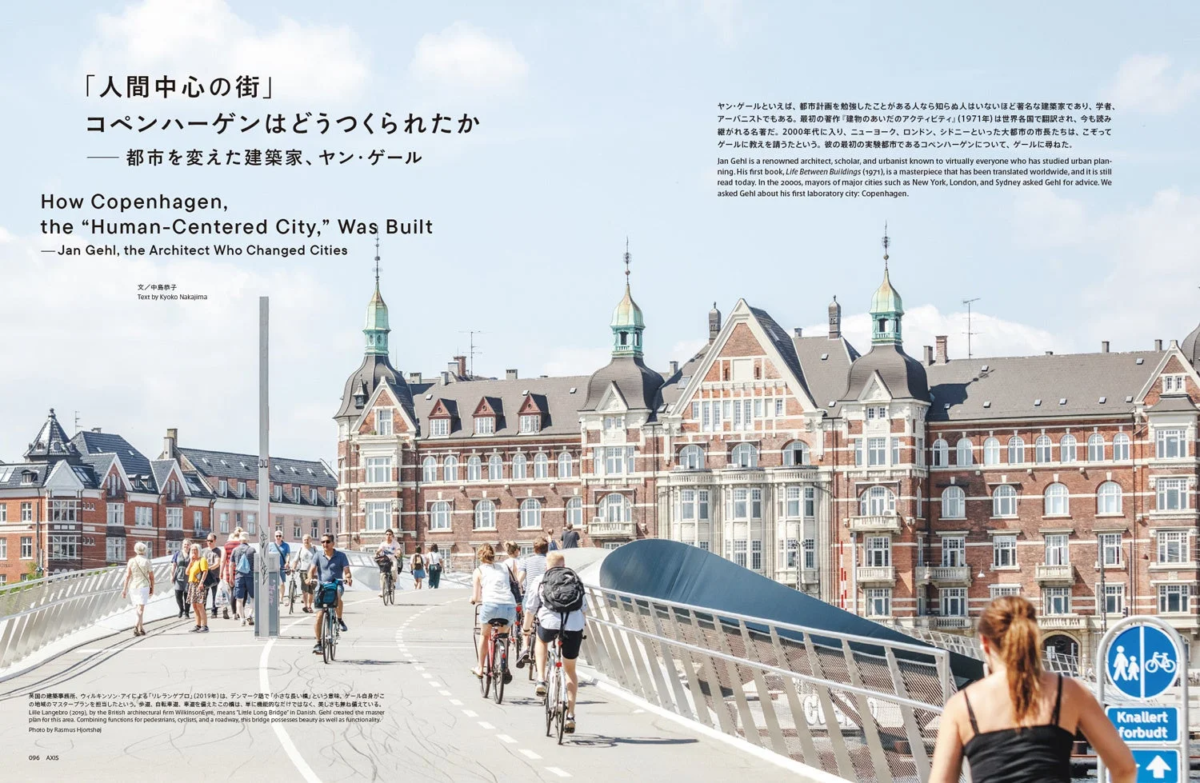
「人間中心の街」 コペンハーゲンはどうつくられたか — 都市を変えた建築家、ヤン・ゲール How Copenhagen, the "Human-Centered City," Was Built — Jan Gehl, the Architect Who Changed Cities 文 / 中島恭子 Text by Kyoko Nakajima ヤン・ゲールといえば、都市計画を勉強したことがある人なら知らぬ人はいないほど著名な建築家であり、学者、アーバニストでもある。最初の著作『建物とあいだのアクティビティ』(1971年)は世界各国で翻訳され、今も読み継がれる名作だ。2000年代に入り、ニューヨーク、ロンドン、シドニーといった大都市の市長たちは、こぞってゲールに教えを請うたという。彼の最初の実験都市であるコペンハーゲンについて、ゲールに尋ねた。 Jan Gehl is a renowned architect, scholar, and urbanist known to virtually everyone who has studied urban planning. His first book, Life Between Buildings (1971), is a masterpiece that has been translated worldwide, and it is still read today. In the 2000s, mayors of major cities such as New York, London, and Sydney asked Gehl for advice. We asked Gehl about his first laboratory city: Copenhagen. 英国の建築事務所、ウィルキンソン・アイズによる「リル・ラングブロ」(2019年)は、デンマーク語で「小さな長い橋」という意味。ゲール自身がこの地域のマスタープランを担当したという。歩道、自転車道、車道を兼ね備えたこの橋は、単に機能的なだけではなく、美しさも兼ね備えている。 Lille Langebro (2019), by the British architectural firm WilkinsonEyre, means "Little Long Bridge" in Danish. Gehl created the master plan for this area. Combining functions for pedestrians, cyclists, and a roadway, this bridge possesses beauty as well as functionality. Photo by Rasmus Hjortshøj 096 AXIS Knallert forbudt

彼の最初の実験都市であるコペンハーゲンが、どのようにして「人間中心の街」へと変貌を遂げたのか、その思想と具体的なアプローチが詳しく紹介されます。

その他の注目コンテンツ

「AXIS」vol.235では、上記特集の他にも、デザインと社会の未来を考察する多様なコンテンツが満載です。

スコープ

  • インダストリアル ロマンティシズムは失われた夢を取り戻すことができるか

  • プロジェッティスタ城谷耕生 — イタリアから雲仙小浜へ ひとりのデザイナーの軌跡

  • Design That Moves You タンジェリンが実践する三層の「Move」

連載

  • Ambience 本とその身体 石塚元太良

  • LEADERS マグヌス・エレベック(マスプロダクションズ創業者)

  • Global Creators Labs レゴデザイン 中島恭子

  • Sci-Tech File 生物進化ってこんなに身近なの!? 街場の雑草進化論 藤崎圭一郎

  • ひとつのピースから チェリー(1946) 野見山桜

  • アフリカの実践者たち マイケル・テテ・ナーテェ(ビスポークデザイナー) ナカタマキ

  • EYES ON K-DESIGN ジヨンキム(ファッションブランド) ユ・ソンジュ

  • 深津貴之の「行ったり来たり」記 生成AI

  • 意思決定のデザイン 心を動かすストーリーテリング/語るべき価値の設計と伝え方 石川俊祐(KESIKI)

  • 太古のクリエイティビティ 壁と感情のデザイン ソウル・漢城百済博物館 港 千尋

  • 詩的工学演習 エネルギー効率のフェティシズム 武井祥平(nomena)

  • 視点モノローグ 停滞 小野直紀

  • はじまりのはじまり 穴と 重なりと 三澤 遥

  • クリエイターズナビ ジャン= バティスト・アノタン、アアティズモ、金森由晃、 スタジオ・オッシディアーナ、リオ・コバヤシ

書籍情報と購入方法

「AXIS」vol.235 winter

  • 発売日: 2025年12月27日

  • 言語: 和英併記(バイリンガル表記)

  • 体裁: A4判変型(274 x 210mm)

  • 定価: 2,500円(税込)

  • 発行: 株式会社アクシス

購入について

最新号は以下の方法で購入できます。

  • オンラインでの購入: Amazon

  • 定期購読: Fujisan.co.jp

  • 書店での購入:全国有名書店でお求めになれます。店頭に在庫がない場合は、お近くの書店にてお取り寄せも可能です。

デザイン誌「AXIS」について

「AXIS」は1981年の創刊以来、デザイン発信拠点「AXIS」とともに、生活と社会におけるデザインの可能性を追求し続けてきたデザイン誌です。独自の特集企画、バイリンガル編集、高品質なレイアウトで、一般誌とは異なる深い視点を提供しています。

2024年7月1日には大幅なリニューアルを実施し、隔月刊から季刊に移行。より深い洞察と厚みのあるコンテンツを通じて、クリエイティブ層やオピニオンリーダーから高い支持を得ています。

AXIS

発行元:株式会社アクシス

株式会社アクシスは1981年の創立以来、東京・六本木のデザイン発信拠点「AXIS」をベースに、デザインの可能性を探求してきました。現在では、デザイン振興活動に加え、ブランディング、グラフィックデザイン、プロダクトデザイン、スペースデザイン、ウェブデザインなどのデザイン開発、コンサルティング、メディア事業、直営店の運営など多岐にわたる事業を展開しています。

「AXIS」最新号は、デザインや建築、社会の未来に興味を持つすべての人にとって、新たな発見と刺激を与えてくれるでしょう。ぜひ手に取って、未来を創造するデンマークのデザイン精神に触れてみてください。


タイトルとURLをコピーしました